A DeReset guide by Arden
Why You're Busy All Day but Still Haven't Started
The First-Move Method: How to Stop Procrastinating at Work and Start the Task You've Been Avoiding
Get The First-Move Method ($27)Guide + workbook + one-page card + bonus · $27 · 30-day money-back guarantee

- 30-day money-back guarantee
- Instant download
- Guide + workbook + one-page card + bonus
- Secure checkout by Gumroad
You know the day
You open the file first thing. You look at it for a minute. Then you think, let me just clear my inbox first.
By lunch you've answered every email, tidied your desk and helped two people with things that weren't urgent. By four o'clock you've done a full day of work. Everything except the one thing that mattered.
So you tell yourself what you told yourself yesterday: first thing tomorrow.
It isn't that you don't know how to do it. You do. It isn't that you don't have time. You did. You just can't make yourself start that one.
What you've already tried
You've probably tried a timer. A to-do app that looked great for a week. A motivational video that, oddly, left you feeling worse. Maybe you've let the deadline do the work, and paid for it with a late night.
And somewhere along the way you started asking the question that makes it all heavier: why am I like this?
The real problem
It isn't laziness. It's the feeling.
Here's what most productivity advice skips. You don't avoid a task because you're lazy. You avoid it because of how it makes you feel right now. Researchers who study procrastination describe it the same way: putting a task off is a way to get away from a bad feeling for a while, and you pay for that later.
The bad feeling has a reason, and the reason is usually specific. The task is unclear. Or it's too big to see the start of. Or it's boring. Or someone important will judge it. Or it has to be perfect, so you can't begin. Or it's someone else's job that landed on you. Or it's already late, and now you're avoiding the person waiting on it, too.
More willpower doesn't fix any of that. What helps is a way to make the first minute feel smaller than the dread.
How it works
How The First-Move Method works
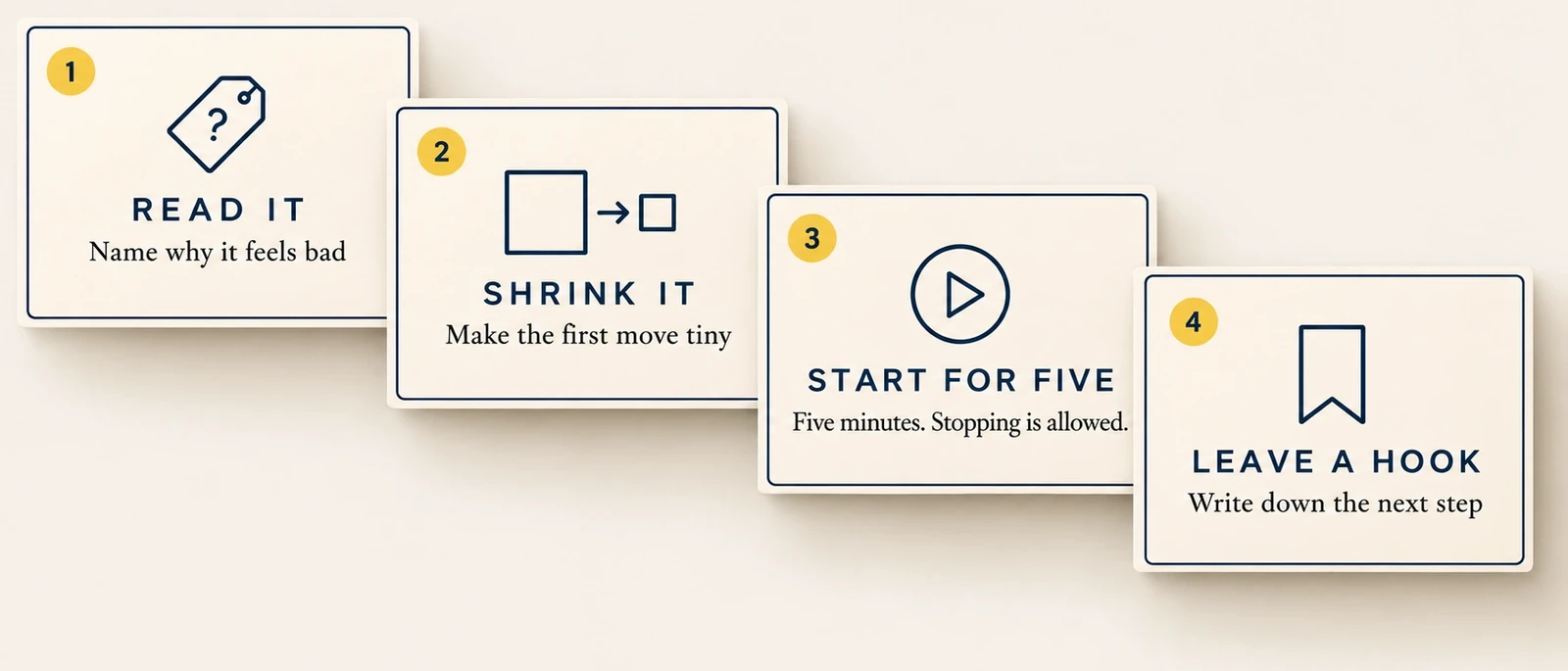
It starts with one signal: you catch yourself dodging. Opening email "for a second". Tidying. A quick favor for someone else. When you notice that, you take out the Start Card and run four moves. It takes about five to seven minutes before you're working.
-
Read it.
Spend sixty seconds picking which reason fits: unclear, too big, boring, fear of judgment, perfect-or-nothing, someone else's task, or already late. Each reason comes with its own first move.
-
Shrink it.
Ask yourself one question: what's the one-sentence version? Turn the task into a first move so small you can't fail it. Not "work on the deck". Open the deck and type the three slide titles.
-
Start for five.
Set five minutes. Do only that first move. You're allowed to stop when the time's up. The dread is usually worst right before you start.
-
Leave a hook.
Before you stop, write the very next step in one line, somewhere you'll see it. Tomorrow's start is already done.
Before and after, ask yourself: "How bad does starting feel, 1 to 10?" There's no number to hit. Just notice the difference.

A typical Tuesday
The budget review has been open since Thursday. At 10:20 you catch yourself reorganizing your inbox folders. You take out the card. The reason is "too big". Your first move is to fill in the first three rows. Five minutes later you've done six, and the next step is written on a sticky note.
What you get
What's inside
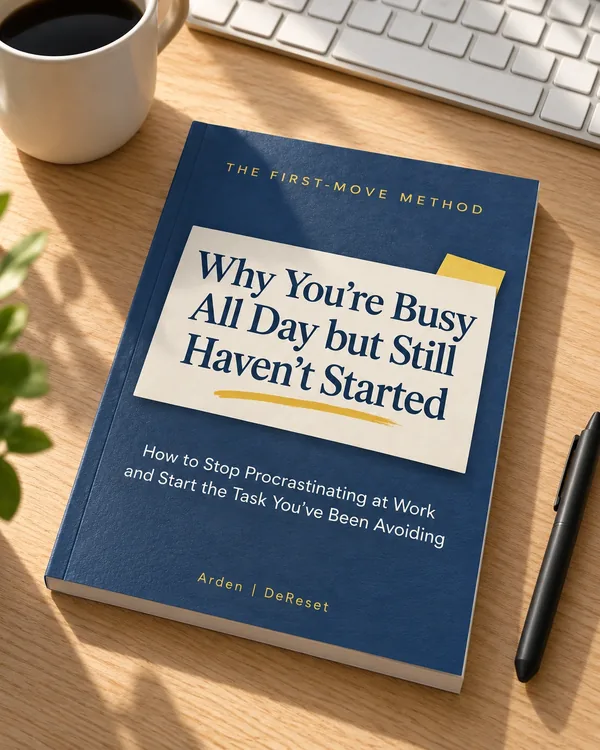
The guide: Why You're Busy All Day but Still Haven't Started
Why work tasks get avoided, how the four moves work, and the seven reasons with examples from real work: reports, decks, emails, budgets, code, proposals and client follow-ups. It also covers what to do when you're interrupted halfway, the 90-second version for bad days, and how to come back after a miss without starting over.
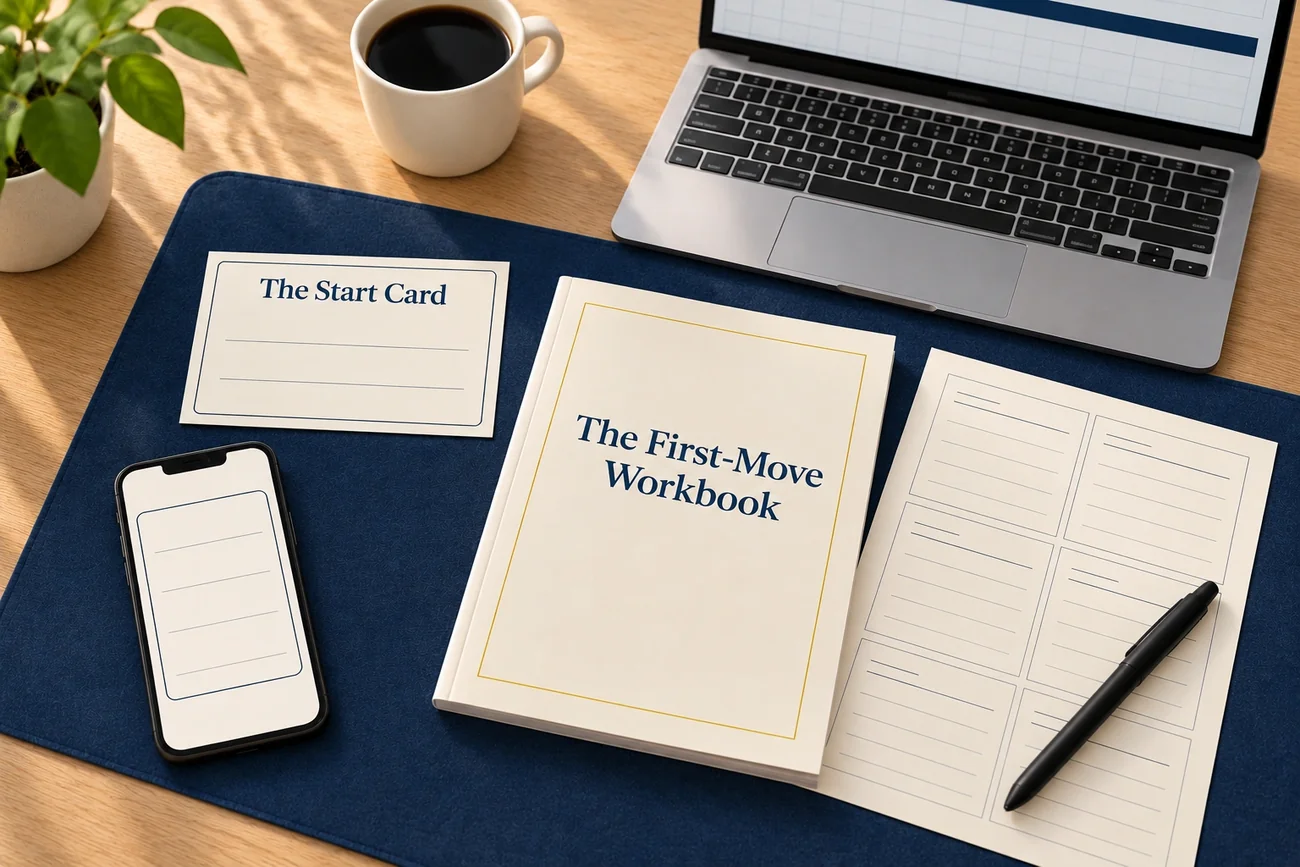
The Start Card
The four moves and the reason-to-first-move map on one page, for the moment you catch yourself dodging. Printable, plus a version sized for your phone. It opens with the question that does the most work: what's the one-sentence version?
The First-Move Workbook
Three short guided sections. The Avoidance Read helps you name the reason fast. The First-Step Builder turns a vague task into a first move you can see, with worked examples. The Two-Week Log records each avoided task, its reason, and your before-and-after number, so you find your most common reason.
The First-Move Tracker (spreadsheet edition, optional)
For people who live in Excel or Google Sheets. Pick a reason from the dropdown and the matching first move appears. Log one row per avoided task, and the Patterns tab shows you your most common reason, which first moves cut the dread most, and how long tasks sit before you start them. No daily entries and no streaks.
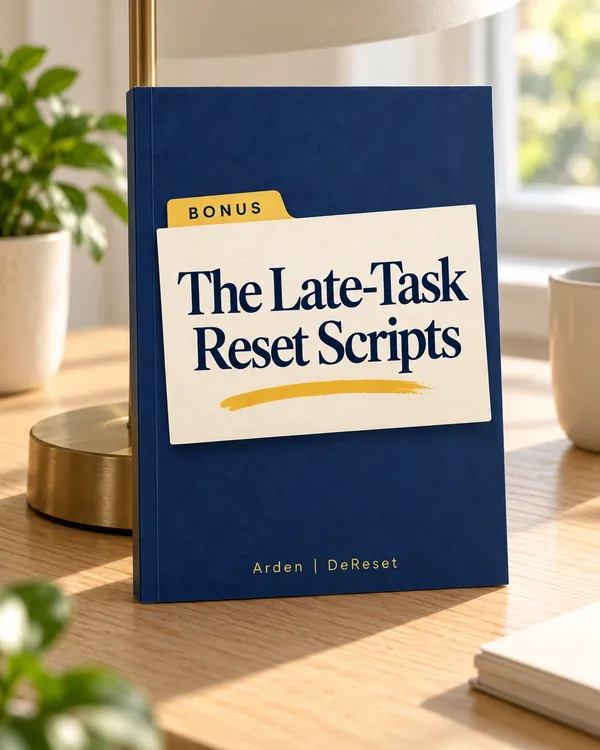
Bonus
The Late-Task Reset Scripts
Short, honest messages for the part nobody talks about. There's a heads-up to send before a task is late, and a reset to send when it already is, to a manager, a client or a colleague. Each comes in an email version and a chat version. Send the message, then start.
Why not just a $5 worksheet?
Most procrastination worksheets give you questions to answer about your habits, away from the task. That's useful for thinking. It doesn't help much at 10:20 on a Tuesday, when the file is open and you're about to check email again.
This is one method built for that moment, at your desk, on a real work task. It gives you a first move matched to the reason you're stuck, and permission to stop after five minutes. It covers the part other guides leave out: what to say when the task is already late. And if you like spreadsheets, there's a tracker that shows you your own pattern.
Getting started
Your first day and your first two weeks
- Day 1
Pick the one task that's been sitting the longest. Do the Avoidance Read, shrink it, and do one Start for five. Write down your before-and-after number.
- Days 2 to 14
Every time you catch yourself dodging, run the card. Log each task in the workbook or the tracker.
- Day 14
Look at your Log. Find the reason that comes up most, and the first move that works best for it.
Miss a day? It doesn't count against you. The next dodge is the next chance.
From the creator
From Arden

The task was a quarterly report for a director I'd never met. It sat in my drafts folder for eleven days.
Every morning I opened it. Then I'd think, let me just clear my inbox first, and suddenly it was 4 p.m. and I'd done everything except the one thing that mattered. I told myself "first thing tomorrow" so many times it stopped meaning anything.
What I didn't admit: by day six I was also avoiding Maren, the director's assistant, who kept sending polite "just checking in!" emails. I'd started routing my walks around her desk.
I tried the usual. Timers. A productivity app I'd abandoned by Wednesday. A motivational video that somehow made me feel worse.
The low point was a Thursday. I stayed until 9 p.m. rewriting the same opening paragraph, then sent Maren a vague "wrapping up soon!" that made me feel like a liar. I cried in my car. Not dramatic crying. Just tired eyes in a parking garage, wondering why I was like this.
What finally worked was small and a little silly. I opened the report and typed one sentence. Not the right sentence. Just: "This quarter, the team focused on three main areas." Nine words.
Then I closed my laptop.
The next morning I added a bullet point. Then another. By Friday it was done. It wasn't perfect. Maren wrote back "thanks!" and I wanted to frame it.
I still avoid things. But now I ask myself one question: what's the one-sentence version? It didn't fix me. It just got me to the desk.
This guide builds that question out so it works on any task, not just reports. There's a quick way to see why a task feels bad, a way to shrink it to a first move you can't fail, five minutes with permission to stop, and a line left for tomorrow. And for when the task is already late, there are honest messages you can send instead of "wrapping up soon!"
The fit
Who it's for
It's for you if:
- You're good at your job, and one task keeps sitting there anyway.
- You stay busy all day, just not with that.
- You want something short you can use at your desk today, not another system to keep up.
It's not the right fit if:
- Your problem is deciding which task to do first. This guide starts once you know what the task is.
- You're looking for help with ADHD, depression or anxiety. A doctor or licensed professional can help with those. This guide doesn't replace that care. You can use it alongside it.
Your order
The offer
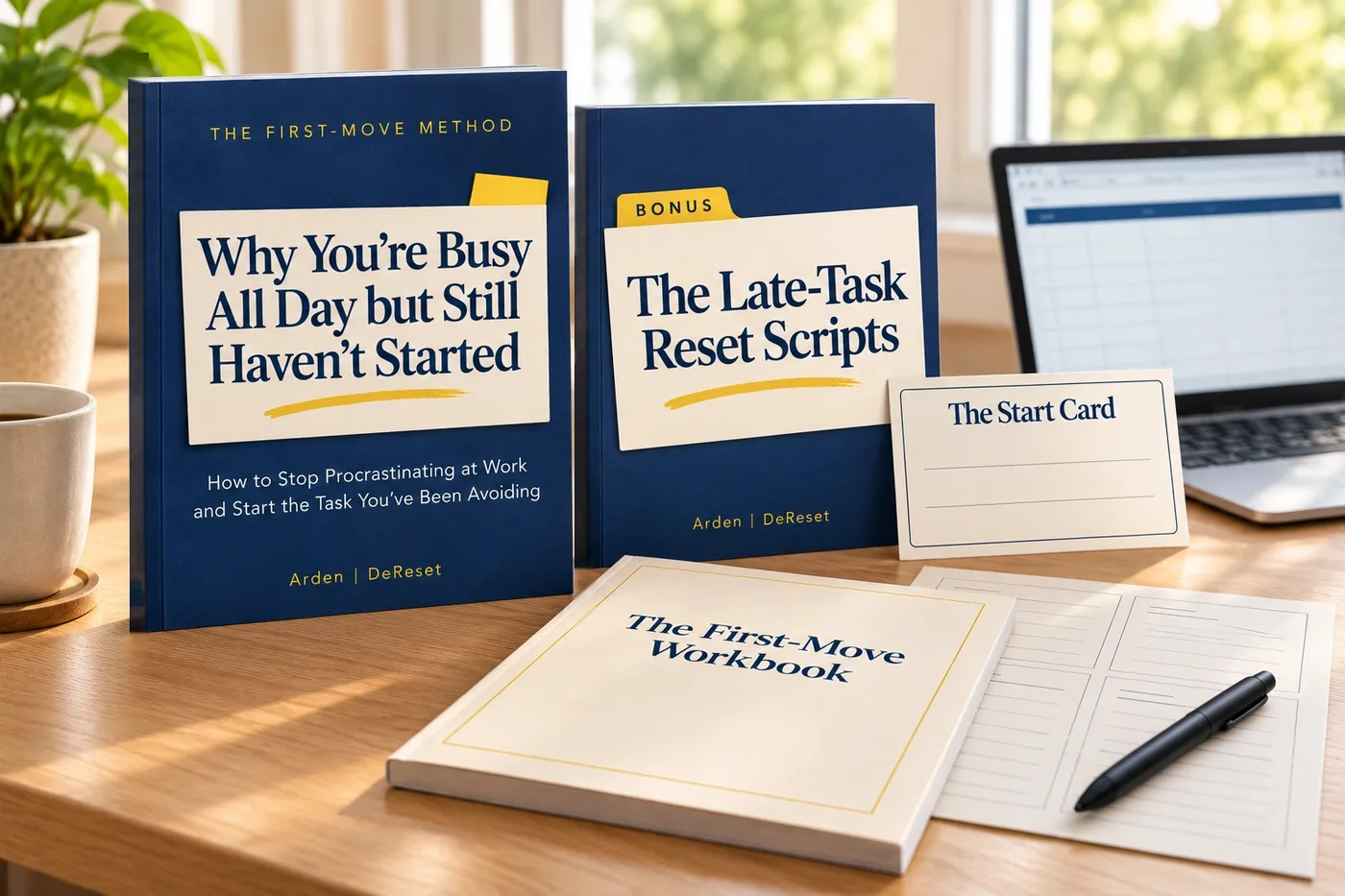
- The guide: Why You're Busy All Day but Still Haven't Started ($27 value)
- The Start Card, printable and phone versions ($8 value)
- The First-Move Workbook ($9 value)
- The First-Move Tracker, spreadsheet edition ($12 value)
- Bonus: The Late-Task Reset Scripts ($17 value)
Total value: $73. Everything for $27.
Get The First-Move Method ($27)
Guarantee
Try The First-Move Method for 30 days. If it doesn't help, email me at [email protected] within 30 days and I'll refund every cent. No hoops.
Use it for your first two weeks. You still have the full 30 days to ask for a refund.
Before you buy
Questions
I think I might have ADHD. Will this work for me?
It may help, but it isn't built for ADHD and doesn't treat anything. If you think ADHD is part of the picture, a doctor or specialist is the right place to start. You can use this alongside their help.
I'm a student. Is this for me?
The method can work on any task, but the examples and the scripts are written for work: managers, clients, colleagues and deadlines.
I'm self-employed or freelance.
It works the same way. The scripts include client versions, and the examples aren't tied to an office.
I have a whole list I'm avoiding. Where do I start?
With the one that's been sitting the longest. This guide doesn't help you rank a list. It helps you start the task you already know you need to do.
I work remotely. Does that change anything?
No one can see you not starting, so the dodge signal matters more at home. The card works on your phone screen, too.
How much time does it take?
About five to seven minutes before you're working, and you can stop after five minutes of work. On bad days, there's a 90-second version.
Do I need the spreadsheet?
No. It's optional. The printable workbook does the same job on paper. The spreadsheet just works out your patterns for you, in Excel or Google Sheets.
What do I get, and how?
Instant download right after purchase. The guide, workbook and bonus are digital files you can read on any device. The card is printable and comes in a phone-sized version. The tracker is a spreadsheet file.
What if it's not for me?
You're covered by the 30-day money-back guarantee above. No hoops.
That task is still there. You know the one.
You don't need to feel ready, and you don't need to finish it today. You need a first move small enough to start.
What's the one-sentence version?
Get The First-Move Method ($27)